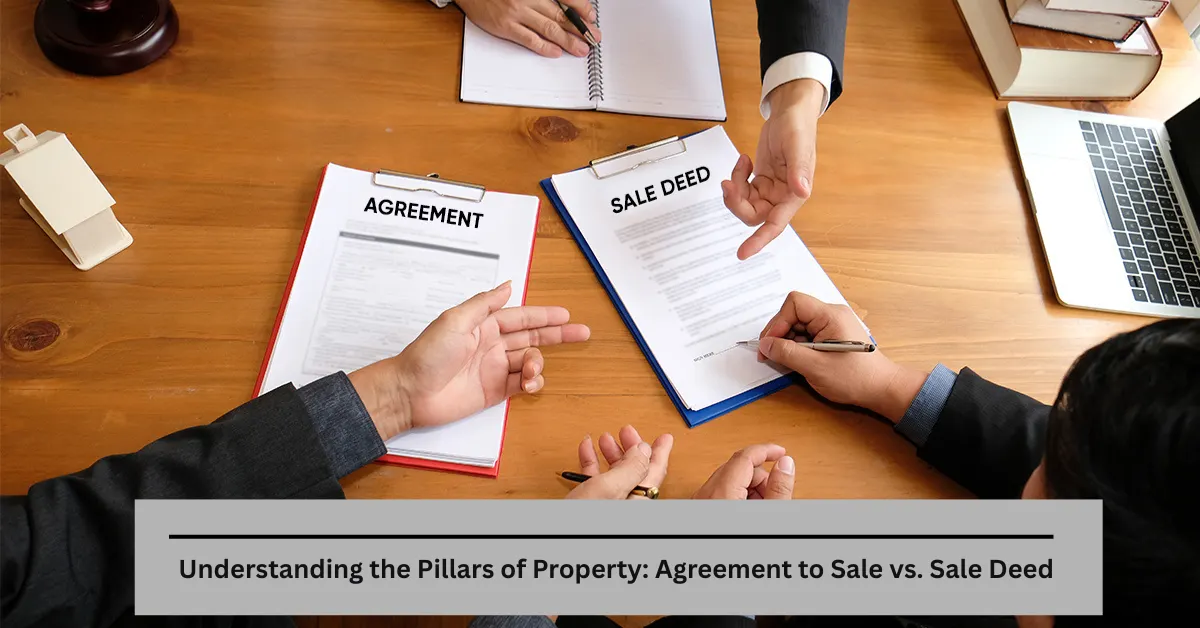
Are you planning to buy a house or apartment in India? Well, that is great news! But let me tell you, once you start dealing with papers, you come across two big terms: the Agreement to Sale and the Sale Deed. People often confuse them, but both are very different. Getting this wrong can seriously mess up your property deal.
Here is the plain truth: an “Agreement to Sale” is only a promise to buy and sell, while the “Sale Deed” is the paper that actually makes you the owner. That is the main difference, and everything else flows from it.
1. The Starting Line: Agreement to Sale (or Agreement to Sell)
Think of the Agreement to Sale as the first handshake, but on paper. It’s the contract that locks both the buyer and the seller into the deal. You sign it when you pay the initial token or advance money.
What is this Paper For?
This agreement is all about setting the ground rules before the big event. It protects both until the final money is paid and the property changes hands. It spells out all the important stuff:
- The Price: The amount that both of you have settled for.
- Payment Plan: How much advance you paid, and the schedule for the rest of the payments.
- The Deadline: A specified date when you have to close the entire sale. If the deal is not closed on this date, there are penalties.
- Conditions: Anything specific that the seller must fix or if this is dependent upon approval of your bank loan.
What if Someone Bails? It clearly states what happens if the buyer or seller violates the contract or how the buyer forfeits the advance money in case of a breach.
Does it Make Me the Owner? Absolutely not. Even if you register this agreement, and even if you have paid half the money, the ownership stays with the seller. The Transfer of Property Act, 1882 (Section 54) makes that super clear. This paper gives you only the right to demand the Sale Deed later, once you fulfill all the conditions. It is not proof of ownership but proof of a ‘contract to own’.
2. The Finish Line: The Sale Deed (or Conveyance Deed)
This is actually the document you’re after. A Sale Deed is that final, heavy-duty legal paper that says, “Okay, the ownership is now 100% transferred from the seller to the buyer.” This is where the magic happens!
What is this Paper For?
The Sale Deed acts as your ‘proof of title’. Once you have a registered Sale Deed, nobody can dispute that you are the legal owner of the property. You get the full right to sell it, rent it out, or take a loan against it.
In the Sale Deed, you find information such as:
- Official Transfer: A clear declaration of the seller transferring all his rights and interest to you.
- Full payment confirmed: A statement that confirms the agreed-upon payment by the seller for the house has been paid in full.
- Guarantee: The seller normally provides a guarantee that the property is completely free from any prior loans, litigation, or claims.
- Handover Date: The exact date the keys and physical possession were given to you.
Getting it Registered is Non-Negotiable
This is very important. According to ‘The Registration Act, 1908’, if a property is being sold, which is worth more than ₹100 basically, every property, then the Sale Deed must be registered. You do this at the Sub-Registrar’s office in the area where the property is located. You pay stamp duty and registration fees here. And if you do not register the Sale Deed, your ownership is just not valid in the eyes of the law. Without that registration stamp, you cannot claim the title.
Quick Check: How the Two Papers Stack Up
| Topic | Agreement to Sale | Sale Deed |
| When it Happens | First step, when advance is paid. | Last step, when full payment is made. |
| Does it Give Ownership? | No. Only a right to get ownership later. | Yes. Transfers title right away. |
| Simple Role | A Promise / A Contract to Sell | Final Ownership Transfer |
| Registration (India) | Usually Optional (depends on state rules/RERA). | Mandatory by law (The Registration Act, 1908). |
| What if Broken? | You can sue to force the sale (Specific Performance). | You sue over the legal title itself or compensation. |
Why Should This Matter to You?
Well, let me tell you about the number one mistake people make out of these two documents, and it can cost you big time.
1. Safety First: An Agreement to Sale is much like your bulletproof vest. It protects you from the sudden price increase by the seller or selling it to someone else because they have gotten a better offer.
2. The Title is Everything: Just because you paid the full amount, never think you own the place. If you don’t have that registered Sale Deed, then you are not the legal owner. In case something goes wrong, you will not have the final legal proof.
3. Bank Loans: Once you apply, your bank will ask to see the registered Sale Deed before it releases the final part of your home loan. Why? Because the bank must make sure property you are buying is legally yours so they have solid collateral.
The bottom line is straightforward: the Agreement to Sale gets the deal started, lays down the rules. But it’s the registered Sale Deed that gives you the keys and the title. So, make sure you get to the finish line: the Sale Deed and get it registered properly!